[Talk] ICPS 2024
Abstract
Silicon colour centres are emerging candidates for quantum technologies that can be readily integrated with silicon-based photonic and electronic devices using existing commercial fabrication processes. The T centre is of particular interest for quantum technologies as it is a spin-photon interface possessing long-lived electronic and nuclear spins, operating in the low-loss telecommunications O-band [1]. It has also been proven to integrate with photonic devices on commercial silicon-on-insulator wafers [2, 3]. Further integration of the T centre with electronic devices is a promising route for developing electrically injected on-chip light sources, single photon sources, as well as approaches for spin–charge readout.
Electronic devices, such as diodes, can complement the optical interface of silicon colour centres, enabling additional techniques to control them and to probe their electronic properties [4]. Using diodes to create regions of tunable Fermi level and performing spectroscopy of T centres in these regions can shed light on its electronic structure and possible charge states, a topic that has been studied using density functional theory but has not yet been observed experimentally [5]. Combined optical and electronic control of T centres also requires designing devices that balance the requirements of the electrical interface with optical performance.
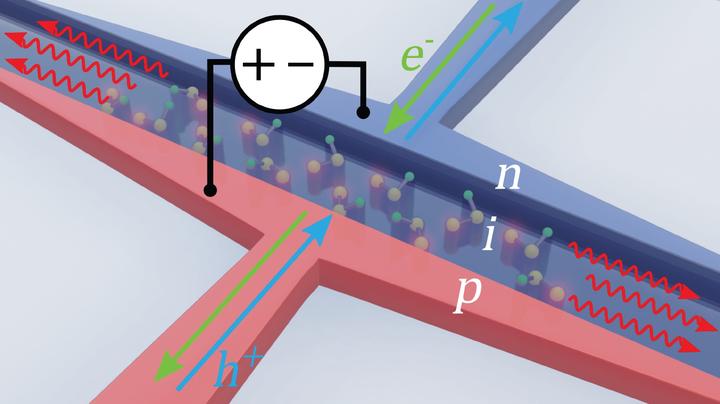
In this work we study electrical integration of T centres with lateral diodes for electrically injected emission. We perform confocal spectroscopic studies of bulk ensembles of T centres in lateral diodes to characterize their optical behaviour under varying Fermi levels and study T centre electroluminescence. We design devices that combine waveguide-integrated T centre ensembles with lateral diodes for electrically injected on-chip light-emitting diodes (LEDs) operating in the telecommunications O-band. Integrating these lateral diodes with cavity-coupled T centre devices we also investigate their potential as an electrically injected single-photon source.
References
[1] L. Bergeron et al., PRX Quantum 1, 2 (2020).
[2] A. DeAbreu et al., Opt. Express 31, 9 (2023).
[3] A. Johnston et al., Nat. Commun 15, 1 (2024).
[4] S. Buckley et al., Opt. Express 28, 11 (2020).
[5] D. Dhaliah et al., Phys. Rev. Mater. 6, 5 (2022).

Michael Dobinson
PhD Candidate
Research interests include quantum computing, optics, photonics, and microelectronics.