Abstract
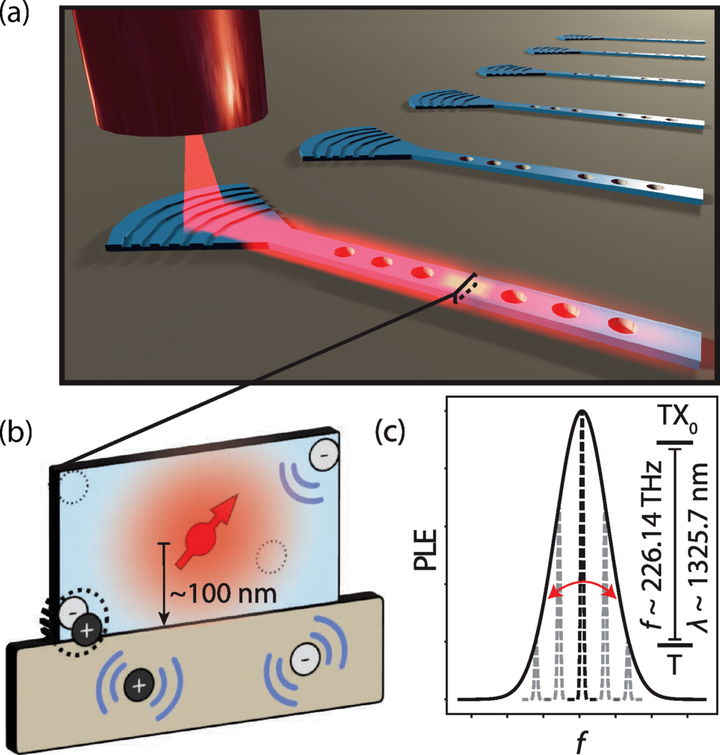
To find practical application as photon sources for entangled optical-resource states or as spin-photon interfaces in entangled networks, semiconductor emitters must produce indistinguishable photons with high efficiency and spectral stability. Nanophotonic cavity integration increases efficiency and bandwidth but it also introduces environmental charge instability and spectral diffusion. Among various candidates, silicon color centers have emerged as compelling platforms for integrated-emitter quantum technologies. Here, we investigate the dynamics of spectral wandering in nanophotonics-coupled individual silicon T centers using spectral correlation measurements. We observe that spectral fluctuations are driven predominantly by the near-infrared excitation laser, consistent with a power-dependent Ornstein-Uhlenbeck process, and we show that the spectrum is stable for up to 1.5 ms in the dark. We demonstrate a factor-of-35 narrowing of the emitter linewidth to 110 MHz using a resonance-check scheme and discuss the advantage for pairwise entanglement rates and optical-resource-state generators. Finally, we report laser-induced spin mixing in the excited state and discuss potential mechanisms common to both phenomena. These effects must be considered in calibrating T-center devices for high-performance entanglement generation.

Michael Dobinson
PhD Candidate
Research interests include quantum computing, optics, photonics, and microelectronics.