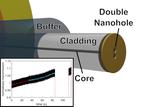
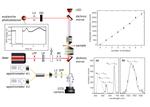
The Nanoplasmonics Research Group at the University of Victoria is supervised by Professor Reuven Gordon. The group focusses on nanoaperture optical trapping using double nanoholes. This technique was first developed by Professor Gordon and is now used by many optical trapping groups around the world. The group’s research is split between quantum computing applications using erbium-doped nanocrystals and protein analysis for biological and drug discovery applications.
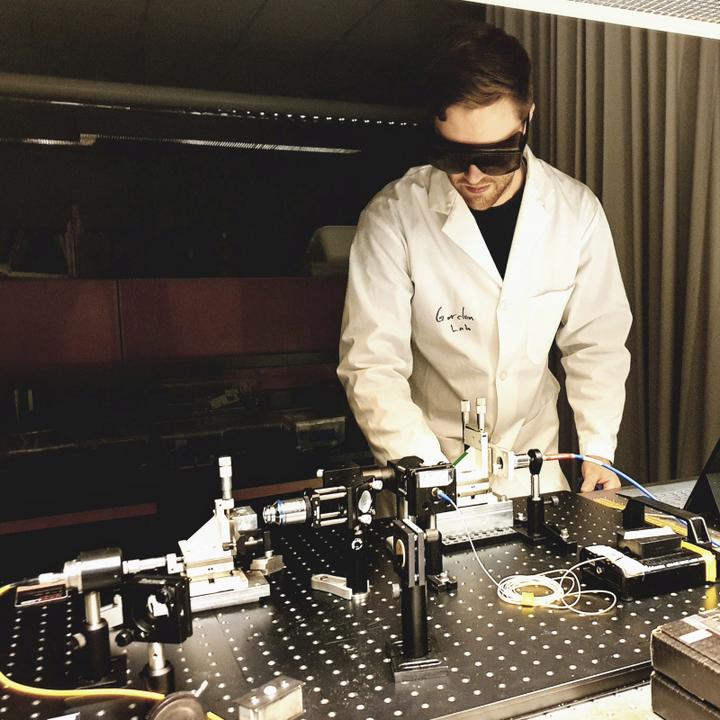

Michael Dobinson
PhD Student
Research interests include quantum computing, optics, photonics, and microelectronics.
Related
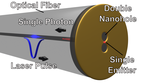
- A route to erbium-doped nanocrystals as a single photon source using double nanohole optical tweezers
- Enhancing and Isolating Lanthanide-Doped Nanocrystals Using Double Nanohole Optical Tweezers for Quantum Light Sources at 1550 nm
- Hexagonal boron nitride second harmonic generation using gold nanorods with continuous laser source
- Accessible High-Performance Double Nanohole Tweezers
- Upconversion nanocrystal emission rate enhancement using double nanoholes
Publications
Nanohole optical tweezers can be used without expensive top-down approaches such as electron microscopy or focused-ion beam milling by using polarization analysis to identify double nanoholes. Different substrates can also improve trapping and tape exfoliation can be used to simplify fabrication.
Ghazal Hajisalem,
Elham Babaei,
Michael Dobinson,
Shohei Iwamoto,
Zohreh Sharifi,
Jon Eby,
Marie Synakewicz,
Laura S. Itzhaki,
Reuven Gordon
Double nanohole optical trapping was used to measure the emission of nanocrystals with discrete levels of erbium ions.
Zohreh Sharifi,
Michael Dobinson,
Ghazal Hajisalem,
Adriaan L Frencken,
Frank CJM van Veggel,
Reuven Gordon
Second harmonic generation is demonstrated in two-dimensional hexagonal boron nitride (hBN) using plasmonic nanorods with low power CW laser excitation.
Mirali Seyed Shariatdoust,
Michael Dobinson,
Ghazal Hajisalem,
Reuven Gordon
The geometry of double nanohole plasmonic apertures can be tuned to provide significant emission enhancement from upconversion nanocrystals, compared to using rectangular apertures.
Zohreh Sharifi,
Michael Dobinson,
Ghazal Haji Salem,
Adriaan L Frencken,
Frank CJM van Veggel,
Reuven Gordon
Gap plasmon structures could enable future ultrafast communication and many of the structures needed have already been developed.
Reuven Gordon,
Michael Dobinson
Plasmon-enhanced optical trapping was used to isolate nanocrystals with discrete levels of erbium ions. These levels were detected by observing discrete levels of emission from the erbium ions. Future work will investigate nanocrystals containing single erbium ions as single-photon sources.
Zohreh Sharifi,
Michael Dobinson,
Ghazal Hajisalem,
Mirali Seyed Shariatdoust,
Adriaan L Frencken,
Frank CJM van Veggel,
Reuven Gordon
Events
A poster presentation about fiber-based nanoaperture trapping titled ‘Nanoaperture optical fiber tweezers fabricated with a low-cost colloidal pattern transfer method’.
Aug 29, 2022 — Sep 2, 2022
University of Victoria